
Technology
Navigating the Digital Maze: Understanding The Error Llekomiss and How to Resolve It


In the modern age of hyper-connectivity, few things are as frustrating as a sudden, cryptic barrier between you and your digital goals. Whether you are a professional trying to meet a deadline, a gamer in the middle of a high-stakes match, or a casual user exploring the web, encountering an unexplained glitch can bring your momentum to a screeching halt. Recently, a specific term has begun to surface in technical forums and community support boards: The Error Llekomiss.
While it may sound like a specialized term from a distant coding language, this error represents a very modern challenge in data synchronization and system handshake protocols. In this 1,000-word deep dive, we will explore the anatomy of this error, why it occurs in the current digital landscape of 2026, and the practical, human-friendly steps you can take to move past it.
1. Decoding the Name: What is “The Error Llekomiss”?
To the untrained eye, The Error Llekomiss looks like a typo or a random string of characters. However, in the world of systems architecture, such names are often derived from the specific sub-routines or “handshake” modules that have failed.
The Anatomy of a Handshake Error
At its core, this error is a synchronization failure. Imagine two people trying to pass a baton in a relay race. If they aren’t running at the same speed, or if one reaches out their hand too early, the baton drops. In digital terms, “Llekomiss” is often associated with the “Link-Level Encoding” (LLE) and the “Key-Ordered Metadata Infrastructure” (KOMI).
When these two systems fail to align, the system generates “The Error Llekomiss.” Essentially, your device is telling you: “I tried to connect to the data stream, but the metadata keys didn’t match the timing of the link encoding.”
2. Why Am I Seeing This Now? (The 2026 Context)
You might wonder why you haven’t heard of this error until recently. As we move deeper into the mid-2020s, our digital infrastructure has become significantly more complex. We are no longer just “loading a website”; we are streaming micro-services from multiple cloud servers simultaneously.
The Rise of Edge Computing
With the transition to 6G and advanced Edge Computing, data is processed closer to the user to reduce lag. While this makes everything faster, it creates more “handshake” opportunities. The Error Llekomiss is frequently a byproduct of a “Temporal Mismatch”—where the local edge server is a fraction of a second ahead of or behind the central cloud database.
Increased Security Layers
Another culprit is the advancement in “Zero-Trust” security. Modern systems verify your identity every few seconds. If a packet of data is sent during a moment of high network congestion, the security “key” might expire before it reaches its destination, triggering the error.
3. Common Scenarios Where the Error Occurs
Understanding the environment in which The Error Llekomiss thrives can help you diagnose the root cause faster.
- High-Fidelity Streaming: Whether it’s 8K video or cloud-based gaming, these services require perfect synchronization. If the link encoding (LLE) fluctuates, the system loses its place in the metadata stream.
- Decentralized Financial Apps (DeFi): In apps that require real-time blockchain validation, any “miss” in the transaction timing can result in this specific error code.
- Smart Home Integration: When multiple devices (lights, cameras, thermostats) try to sync with a single hub simultaneously, the “KOMI” (Metadata Infrastructure) can become overwhelmed, leading to a temporary system freeze.
4. Step-by-Step Solutions: Fixing the Glitch
The good news is that while The Error Llekomiss sounds intimidating, it is rarely a sign of permanent hardware damage. It is usually a “soft” error that can be resolved with a few logical steps.
Phase 1: The Refresh and Reset
It sounds cliché, but 90% of sync errors are resolved by clearing the immediate “memory” of the connection.
- Clear the Local Cache: Go into your application or browser settings and clear the temporary data. This forces the “LLE” module to start a fresh handshake.
- The “60-Second” Power Cycle: Unplug your router or modem for a full minute. This clears the “stale” metadata keys held by your ISP’s local node.
Phase 2: Network Optimization
If the error persists, the issue might be “Network Jitter”—the technical term for an unstable connection.
- Switch to a Wired Connection: If you are on Wi-Fi, try an Ethernet cable. Wi-Fi is prone to interference that can break the “Link-Level Encoding.”
- Disable “Burst Mode” on Routers: Some modern routers have a feature that sends data in large bursts. While great for downloads, it can confuse sensitive sync protocols like those found in the Llekomiss framework.
Phase 3: Update and Re-Verify
Sometimes, the error is caused by an outdated “handshake” protocol on your device.
- Check Firmware Updates: Ensure your OS or the specific app is running the latest version. Developers frequently release “hotfixes” for these types of timing errors.
- Synchronize System Time: This is a vital but often overlooked step. Go to your settings and ensure your device time is set to “Automatic.” If your clock is even two seconds off from the server, the metadata keys will fail.
5. Myth-Busting: What “The Error Llekomiss” IS NOT
In the age of viral misinformation, it’s easy for technical terms to be misinterpreted. Let’s clear up a few misconceptions:
- It is not a virus: While frustrating, this error is a communication failure, not a malicious attack on your files.
- It does not mean your device is “old”: In fact, this error is more common on newer, high-speed systems that use advanced encoding than on older, simpler machines.
- It is not a “shadow ban”: Some users worry that seeing an error means they have been restricted from a service. “Llekomiss” is strictly a technical hurdle, not a social or account-based one.
6. Preventing Future Occurrences
Once you have resolved The Error Llekomiss, you likely want to ensure it doesn’t return. Maintaining a “healthy” digital environment is the best defense.
Invest in Stable Hardware
High-quality routers with “Smart Queue Management” (SQM) are designed to handle the complex metadata streams of 2026. These routers prevent any single device from “hogging” the LLE bandwidth.
Monitor Background Tasks
Many of us have dozens of apps running in the background, all competing for a handshake with their respective servers. Closing unused applications reduces the “noise” in your metadata infrastructure, making it easier for your primary task to stay synced.
7. Conclusion: Human Persistence in a Digital World
Encountering The Error Llekomiss can feel like hitting a brick wall in the dark. However, by understanding that this is simply a “misunderstanding” between two complex digital systems, we take away the mystery and the frustration.
Technology is a tool designed to serve us, but like any tool, it sometimes requires a moment of maintenance and a patient hand. By following the steps of clearing your cache, ensuring your system time is accurate, and stabilizing your connection, you can conquer this glitch and return to your digital journey with confidence.
In the ever-evolving landscape of 2026, errors will come and go, but with the right information, the user always stays in control.
The phrase “ETSJavaApp release date” has quietly become a trending search term among developers, tech followers, and even niche communities interested in enterprise tools and digital systems. Yet, unlike typical software launches, this one feels unusually mysterious.
There’s no flashy countdown. No official keynote announcement. No confirmed release day.
So what’s actually going on?
To understand the situation properly, you need to look beyond just “when it will release” and start asking a better question: why hasn’t it been released yet?
The Confusion Around ETSJavaApp
One of the biggest reasons people struggle to find a clear release date is simple—ETSJavaApp itself is not clearly defined in public space.
Depending on where you look or who you ask, it’s described as:
- A Java-based enterprise solution
- A backend-heavy system for managing large-scale operations
- A tool linked to tracking, analytics, or simulation-style environments
- Or even something experimental still being shaped
This lack of a fixed identity creates a ripple effect:
👉 No clear product identity = No clear launch strategy = No clear release date
So… Is There a Release Date?
Let’s be direct:
As of now, ETSJavaApp does not have an officially announced release date.
Not “hidden.” Not “leaked.” Not “soft-announced.”
Just… not available.
And that actually tells us something important—this is not a typical commercial app rushing to market. It’s likely being developed with a different mindset.
Reading Between the Lines: What the Timeline Suggests
Even without an official date, we can still build a realistic picture.
From scattered development signals and discussions, a rough timeline looks like this:
- Early development phase: Likely started quietly before public attention
- Testing phase: Activity began surfacing around 2024
- Expected release window (missed): Sometime in 2024–2025
- Current expectation: Still in progress, possibly targeting stability over speed
This pattern is extremely common in projects that are:
- Technically complex
- Not backed by aggressive marketing
- Still evolving in scope
Why the Delay Might Actually Be a Good Sign
Most people see delays as a problem. In reality, in software development, delays often mean something else entirely: the team is not cutting corners.
Here are some likely reasons why ETSJavaApp hasn’t been released yet.
1. It Might Be Bigger Than Originally Planned
Projects often start small and then expand once developers realize the potential.
What may have started as a simple Java tool could now be turning into:
- A full platform
- A modular system
- Or a multi-purpose environment
That kind of growth doesn’t happen on a fixed schedule.
2. Stability Matters More Than Speed
Java-based systems are usually designed for:
- Reliability
- Scalability
- Long-term use
Releasing too early could damage trust, especially if the target users are businesses or developers.
3. Silent Development Strategy
Not every project uses hype marketing.
Some teams prefer:
- Building quietly
- Testing privately
- Releasing only when fully confident
If ETSJavaApp follows this model, the silence isn’t a problem—it’s intentional.
What ETSJavaApp Is Expected to Offer
Even though details are not officially locked in, we can still talk about what kind of system this is likely to become, based on its name and development patterns.
A Strong Java Foundation
The “Java” in ETSJavaApp is not just branding—it suggests:
- Cross-platform capability
- Backend strength
- Enterprise-level performance
This alone positions it differently from lightweight apps.
A Focus on Systems, Not Just Features
Instead of being a single-purpose tool, ETSJavaApp may act more like a framework or environment where multiple functions exist together.
Think less “app” and more “ecosystem.”
Flexibility and Integration
Modern tools are expected to connect with everything:
- APIs
- Databases
- External services
If ETSJavaApp aims to compete seriously, integration will likely be one of its core strengths.
Who Is Actually Waiting for This?
Interestingly, the audience is not casual users.
The interest seems to come from:
- Developers looking for new Java-based tools
- System architects exploring scalable solutions
- Tech communities tracking emerging platforms
This kind of audience doesn’t just want a release—they want something worth adopting.
The Risk of Rushing It
Let’s flip the perspective for a second.
If ETSJavaApp were released tomorrow—but:
- Full of bugs
- Poorly optimized
- Lacking clear documentation
…it would likely fail quickly.
In that sense, waiting longer might actually protect the project’s future.
When Can We Realistically Expect It?
No hype. No guessing games. Just logic.
Based on how similar projects evolve:
- If development is still active → release is not immediate
- If testing phases are ongoing → stability is still being refined
- If there’s no official communication → launch strategy is not finalized
Realistic expectation:
👉 A proper public release would only happen when the product is fully defined, stable, and ready to scale.
That could be:
- Later in 2026
- Or even beyond
What You Should Do Right Now
If you’re interested in ETSJavaApp, the best approach is not to wait blindly.
Instead:
- Keep an eye on developer discussions
- Look for early access or beta mentions
- Focus on alternatives in the meantime
- Be cautious of fake “release date” claims
Final Thoughts
The search for the ETSJavaApp release date is really a search for clarity in a project that is still evolving.
And that’s the key point.
This isn’t a delayed product—it’s an unfinished one.
But that’s not a bad thing.
In fact, some of the most powerful tools in tech history took longer than expected because they were built carefully, not quickly.
If ETSJavaApp follows that path, the wait might be longer—but the result could be far more meaningful.
By Drake Miller
For today’s American high school and college students, the “campus experience” has undergone a massive digital transformation. Whether you are attending a state university or completing an online high school diploma, the shift toward virtual classrooms has brought unprecedented flexibility. However, it has also created a unique challenge: the blurring of lines between “school time” and “me time.”
In my experience working with digital-first students, I’ve seen that the biggest hurdle isn’t the difficulty of the curriculum—it’s the environment. When your bedroom is your lecture hall and your laptop is both your textbook and your Netflix screen, how do you keep your grades up without sacrificing your sanity? Mastering how to balance school and social life is no longer just a “soft skill”—it is the ultimate survival tactic.
In this guide, I’m breaking down the science of online learning tips for students so you can excel in your courses while remaining the life of the party (or the group chat).
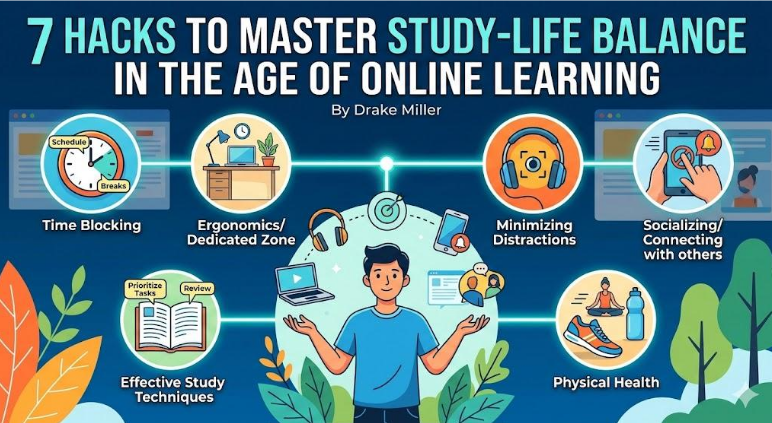
1. Master the “Time-Block” Method for Deep Work
The biggest myth of American student life is that you need to be “busy” to be successful. In reality, the highest-achieving students rely on deep work. Instead of a vague, overwhelming to-do list, try Time-Blocking. This involves assigning specific “containers” of the day to specific tasks to prevent schoolwork from bleeding into your social hours.
A sample productive routine for online school might look like this:
- 8:00 AM – 9:00 AM: Morning ritual (Coffee, gym, or sunlight).
- 9:00 AM – 11:30 AM: High-intensity study (The “Frog” task—writing papers or solving complex math).
- 12:00 PM – 1:00 PM: Social check-in and lunch.
- 1:00 PM – 4:00 PM: Attending Zoom lectures or responding to discussion boards.
- 6:00 PM onwards: Total digital shutdown for social life and relaxation.
If you find yourself overwhelmed by a mounting pile of assignments during these blocks, don’t be afraid to leverage external resources. I’ve often seen that using professional essay help at Myassignmenthelp.com can provide the necessary academic help to stay on track when the workload feels unmanageable. Delegating complex research or formatting tasks allows you to maintain your study-life balance without failing your courses.
2. Audit Your “Digital Drain” and App Fatigue
Before you can manage your time, you have to know where it’s leaking. Many students struggle with how to focus on online classes because the digital environment is designed for “micro-distractions.” In the US, the average Gen Z student spends over 4 hours a day on social media alone.
The Trap: Picking up your phone for a “two-minute break” from a Chemistry module, only to find yourself 40 minutes deep into a TikTok rabbit hole.
The Fix: Use built-in screen time trackers to identify which apps are eating your productivity. I recommend utilizing “Focus Modes” on iOS or Android to silence notifications from 9 AM to 2 PM. Treating your virtual lectures with the same “no-phone” respect as a physical classroom is the first step toward reclaiming your evenings.
3. Create a “Third Space” to Fight “Bedroom Burnout”
One of the hardest parts of online education is the lack of physical transition. When you study in bed, your brain stays in “rest mode,” making it harder to retain information. Conversely, when you try to sleep in your “classroom,” your brain stays in “stress mode.”
To optimize your study-life balance for college students, you must establish a dedicated study nook. This doesn’t require a home office; it can be a specific corner of the kitchen, a local library, or a Starbucks. The goal is to signal to your brain: “When I am here, I am a student. When I leave, I am free.”
4. The “Syllabus Hack”: Stay Ahead of the Curve
The greatest advantage of online courses (especially in platforms like Canvas or Blackboard) is that the entire curriculum is often laid out in advance. Procrastination is the primary enemy of a thriving social life. If you know a major concert or a weekend trip is coming up, the “Syllabus Hack” is your best friend.
Aim to stay 2–3 days ahead of your deadlines. Before you start writing, make sure you understand the essay marking scheme , this ensures you aren’t wasting time on sections that don’t earn points. If you have a discussion post due Friday, finish it on Tuesday. This creates a “buffer zone” so when a last-minute invitation pops up, you can say “yes” without the looming anxiety of an 11:59 PM deadline.
5. Leverage “Social Productivity” (The Body Doubling Hack)
Who says socializing and studying have to be mutually exclusive? In the US, “Body Doubling”—the practice of working alongside someone else to improve focus—has become a massive trend.
- Virtual Study Rooms: Use Discord or Zoom to host “Co-working” sessions with friends. Stay on mute, work for 50-minute sprints, and use the 10-minute breaks to catch up.
- The “Teach-Back” Method: If you’re hanging out with classmates, take turns explaining a difficult concept. It reinforces your memory and keeps you connected socially.
6. Prioritize “Quality Over Quantity” in Socializing
In an era where “social-emotional learning” is prioritized, we know that isolation is a productivity killer. However, “hanging out” doesn’t always mean being social. If you’re spending four hours in the same room as your friends while everyone is silently scrolling on their phones, you aren’t actually recharging your batteries.
Aim for High-Quality Socializing to prevent burnout:
- Plan “Analog” Outings: A hike, a concert, or a “no-phones” dinner.
- Campus Involvement: Join a school club or an intramural sports league.
- Intentional Connection: One hour of genuine, face-to-face connection is more restorative than five hours of “passive” hanging out.
7. Recognize the Red Flags of Academic Burnout
Academic burnout is a significant issue in the U.S. education system, where the pressure to maintain a high GPA is constant. If you find yourself staring at a blank Google Doc for an hour, or if you’re canceling social plans because you’re “too exhausted” to even speak, you are likely hitting a wall.
Being a “smart” student means knowing when to ask for help. Whether it’s reaching out to a TA for an extension, joining a peer tutoring group, or utilizing academic tools to structure your research, recognizing your limits is a sign of maturity. You aren’t a robot; you are a student navigating a complex, digital-first world.
Frequently Asked Questions
Q.1 How do I stay motivated when taking online classes from home?
The key is environmental association. Avoid working in the same space where you relax. Additionally, using the Pomodoro Technique—working for 25 minutes followed by a 5-minute break—prevents mental fatigue.
Q.2 Is it possible to have a social life while being a full-time online student?
Absolutely. If you treat your school hours like a 9-to-5 job and finish your “Deep Work” by late afternoon, your entire evening is guilt-free for social events or part-time work.
Q.3 What should I do if my online course load becomes overwhelming?
Start by communicating with your instructor. If you are struggling with specific academic hurdles, using a trusted assignment help service can help you manage the overflow, allowing you to focus on high-priority exams while maintaining your mental health.
Q.4 What are the best tools for managing a student schedule in 2026?
Digital calendars like Google Calendar are essential for time-blocking. For task management, apps like Notion or Trello allow you to visualize your entire semester syllabus at a glance.
About the Author: Drake Miller
Drake Miller is a digital education consultant and student success coach based in Chicago. With over 8 years of experience helping high school and college students navigate the transition to hybrid and online learning, Drake specializes in productivity frameworks and “social-first” academic strategies. He is a frequent contributor to student lifestyle publications and holds a Master’s in Educational Psychology.

In a time when new names and platforms appear almost daily, Bluepha stands out as a concept built around clarity, simplicity, and purposeful innovation. Rather than being just another brand name in a crowded digital marketplace, Bluepha represents a mindset — one that blends efficiency with creativity and technology with human-centered thinking.
The Idea Behind Bluepha
At its core, Bluepha symbolizes calm intelligence. The word itself suggests something modern and refined, yet approachable. In a world overloaded with complex systems and overwhelming choices, Bluepha focuses on making experiences smoother, smarter, and more intuitive.
Whether applied to technology, digital services, design, or lifestyle products, the philosophy behind Bluepha remains the same:
remove friction, enhance usability, and prioritize real human needs.
Why Simplicity Matters More Than Ever
Today’s users expect speed and ease. Complicated interfaces and confusing processes quickly drive people away. Bluepha embraces minimalism — not as an aesthetic trend, but as a functional principle.
Simplicity means:
- Clear communication
- Thoughtful design
- Seamless user experience
- Efficient performance
Instead of overwhelming users with features they rarely use, Bluepha focuses on delivering exactly what is needed — nothing more, nothing less.
Bluepha and Innovation
Innovation does not always mean adding more. Sometimes it means refining what already exists. Bluepha encourages intelligent improvement rather than unnecessary expansion.
This approach includes:
- Streamlining digital tools
- Enhancing accessibility
- Improving responsiveness
- Building scalable yet adaptable systems
True innovation solves real problems. Bluepha prioritizes practicality over hype.
Building Trust Through Transparency
Modern consumers value transparency. Bluepha’s philosophy supports open communication, honest messaging, and reliable performance. Trust is not built overnight; it grows from consistent delivery and genuine engagement.
When users feel understood and supported, loyalty follows naturally.
The Future Vision of Bluepha
Looking ahead, Bluepha has the potential to evolve into a broader ecosystem — one that bridges creativity, technology, and user-focused design. As digital landscapes continue to expand, the need for clarity and simplicity will only increase.
Bluepha’s guiding principle remains steady:
technology should adapt to people, not the other way around.
Final Thoughts
Bluepha is more than just a keyword — it represents a modern philosophy centered on smart simplicity, thoughtful design, and meaningful innovation. In an increasingly complex world, approaches like Bluepha remind us that progress doesn’t have to be complicated. Sometimes, the most powerful solutions are the most refined.

Engineering the Snap: How RYAN London Masters MagSafe Attraction in Fine Italian Leather

How NJ Employment Lawyers Can Help with Discrimination Based on Gender Identity
The Evolution of Online Hold’em: Navigation, Mechanics, and Strategic Mastery

How Everyday Items Are Becoming Meaningful Style Statements

WaveTechGlobal: The Tech Guru Shaping the Future of Innovation

The HakEvent 2024: The Online Event of the Year
Engineering the Snap: How RYAN London Masters MagSafe Attraction in Fine Italian Leather
How NJ Employment Lawyers Can Help with Discrimination Based on Gender Identity
The Evolution of Online Hold’em: Navigation, Mechanics, and Strategic Mastery
-
 Lifestyle11 months ago
How Everyday Items Are Becoming Meaningful Style Statements
-
 Technology2 years ago
WaveTechGlobal: The Tech Guru Shaping the Future of Innovation
-
 Business2 years ago
The HakEvent 2024: The Online Event of the Year
-

 Health2 years ago
What is the Cost for a Mobile Chiropractor Visit?
-

 News2 years ago
Ontpress FreshUpdates: The Future of Timely and Trustworthy Information
-

 Entertainment2 years ago
EmbersLasVegas Esports: The Ultimate Destination for Gamers and Fans
-

 Blog2 years ago
Better This Facts Tips from BetterThisWorld to Elevate Your Personal Growth
-

 Technology2 years ago
Why Should I Buy the Civiliden LL5540?